Channel vs. Clamps: How Your Shower Glass Is Held in Place
By Direct Shower Door · October 2, 2026 · 7 min read
Every frameless enclosure with a fixed panel, whether a door and inline panel, a splash panel or a corner unit, needs something to hold that panel securely to the wall and the curb. There are two main ways to do it: a continuous metal U-channel, or a set of small clamps. Both are strong and both are common. They look different, clean differently, and handle uneven walls differently.
This guide explains each, compares them in plain terms, and helps you choose what suits your bathroom.
The short answer
Clamps are small individual brackets. They give the most minimal, open look and leave no track for water to sit in.
U-channel is a slim continuous metal profile the glass sits in. It gives a clean, uniform line and is forgiving of walls and curbs that are not perfectly straight.
Both are finished to match your hardware, in any of our six finishes.
How Clamps Work
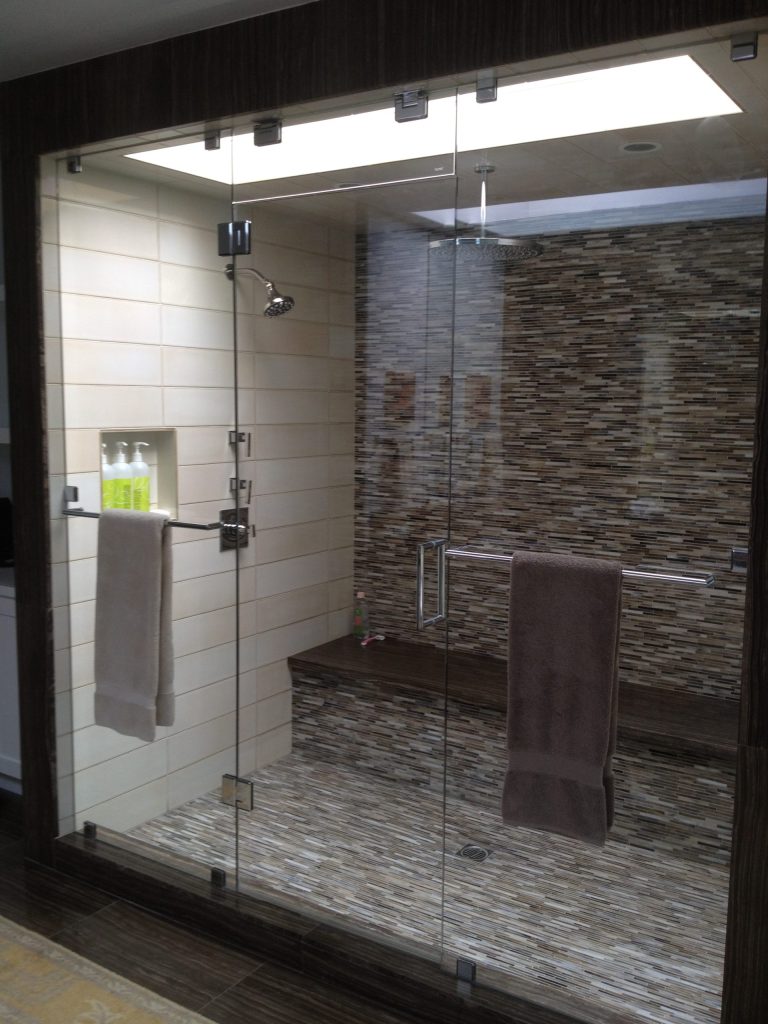
Clamps are compact metal brackets fixed to the wall or curb, each gripping the edge of the glass. A typical fixed panel has two clamps on the wall side and two on the curb. Glass-to-glass clamps join panels to each other, for example at the corner of a 90 degree enclosure.
Because there is so little metal, clamps give the most “frameless” look: the glass appears to float with just a few small points of hardware.
How U-Channel Works
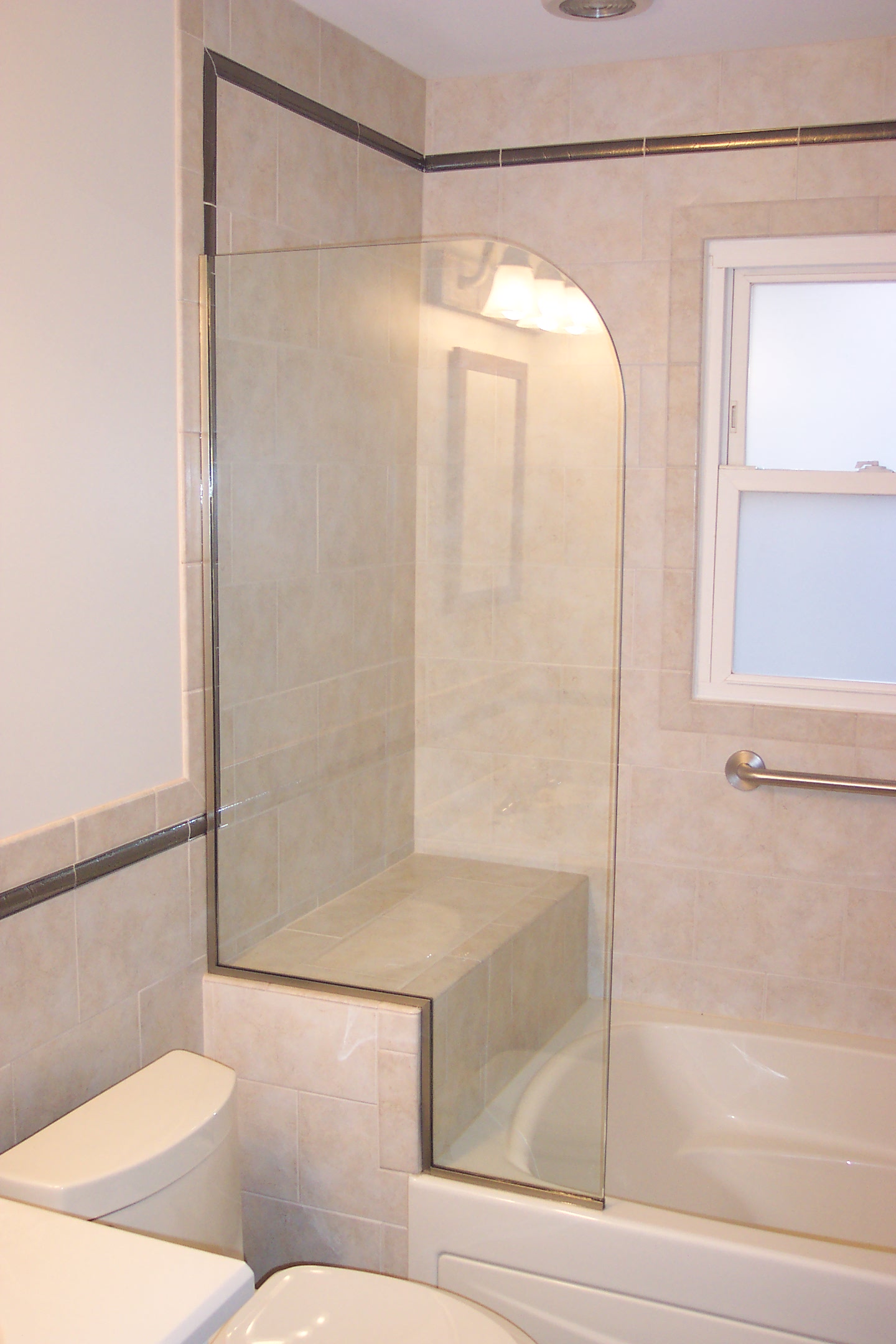
A U-channel is a slim, continuous metal profile, shaped like a narrow U, fixed along the wall or the curb. The glass sits inside it, held firmly with setting materials. From the outside you see a thin metal line along the edge of the glass.
Channel gives a crisp, uniform edge, and because it runs the full length, it supports the glass along its whole edge rather than at points.
Side by Side
Look
Clamps are the most minimal. Channel adds a slim continuous line, which some homeowners prefer because it frames the glass neatly, especially in a strongly linear modern bathroom. In matte black or satin brass, a channel line can be a deliberate design feature.
Cleaning
Clamps win here. With only a few small brackets, there is almost nothing to clean around, and no track along the curb for water and soap to sit in. A channel along the curb needs a wipe along its edge as part of your weekly clean. Our care guide covers both.
Uneven walls and curbs
Channel is more forgiving. Walls are rarely perfectly plumb and curbs are often sloped, and a channel can absorb small variations along the edge of the glass. Clamps hold the glass at points, so the glass has to be cut precisely to the actual shape of the opening. That is part of why we measure every opening carefully before cutting. See how to measure a shower opening.
Water
Both fixings are sealed at installation and keep water in when installed properly. Water control depends more on door seals, the sweep and the shower layout than on the panel fixing.
Strength
Both are strong and secure when correctly specified for the glass size and thickness. Larger or heavier panels may also use a support bar to the wall or ceiling.
Which Should You Choose?
Choose clamps if
You want the most minimal, floating-glass look.
Easy cleaning is a priority.
Your walls and curb are reasonably straight.
Choose channel if
You like a clean, continuous line along the glass edge.
Walls or the curb are noticeably out of plumb or uneven.
The design leans strongly linear and you want hardware lines to echo it.
Often the answer is a mix: clamps where the look matters most and channel where the walls are least regular. We recommend what suits your opening at the measure.
What About the Door?
Channel and clamps hold fixed panels. Hinged doors hang on hinges, either wall-mounted or glass-to-glass, and sliders hang from a top rail. All the hardware on an enclosure comes in the same finish: polished chrome, polished nickel, satin brass, oil rubbed bronze, matte black or brushed nickel. See our finish guide and the hardware on our Hardware & Glass page.
Channel vs. Clamps at a Glance
Clamps
U-channel
Look
Minimal, glass appears to float
Slim continuous line
Cleaning
Easiest
Wipe the channel edge weekly
Uneven walls
Glass cut precisely to the opening
More forgiving
Support
At points
Along the full edge
Finishes
All six
All six
Hinges: The Other Hardware on Show
Fixed panels use channel or clamps, and doors hang on hinges. We offer two hinge and clamp families so everything on the enclosure matches:
Square hinges and clamps have crisp, squared edges. They suit modern bathrooms and pair with square and mitered handles.
Beveled hinges and clamps have softened, angled edges. They suit transitional and classic bathrooms and pair with tubular and traditional handles.
Splash panel: clamps for the most minimal look, or channel along the floor for a clean line. A support bar may be added on larger panels.
Door and inline panel: the fixed panel uses clamps or channel; the door hangs on hinges.
90 degree corner and neoangle: glass-to-glass clamps join the panels; wall clamps or channel hold the returns.
Steam enclosures: the fixing is chosen with sealing in mind, since every gap must be closed.
Common Mistakes
Choosing clamps on badly uneven walls without discussing it. Clamps are fine on most walls, but very uneven surfaces may suit channel better.
Letting soap build up in a channel. A weekly wipe keeps it clean.
Mixing finishes between clamps, hinges and handle. One finish across the enclosure looks best.
Support Bars Explained
Large fixed panels sometimes need extra stiffening beyond the clamps or channel. A support bar runs from the top edge of the glass to a wall, or to the ceiling, and stops the panel from flexing. You will see them most often on:
Wide splash panels on walk-in showers, where the panel has a free edge.
Tall panels where the glass is not supported at the top.
Enclosures with a door hanging from a fixed panel, where the panel takes the door’s weight.
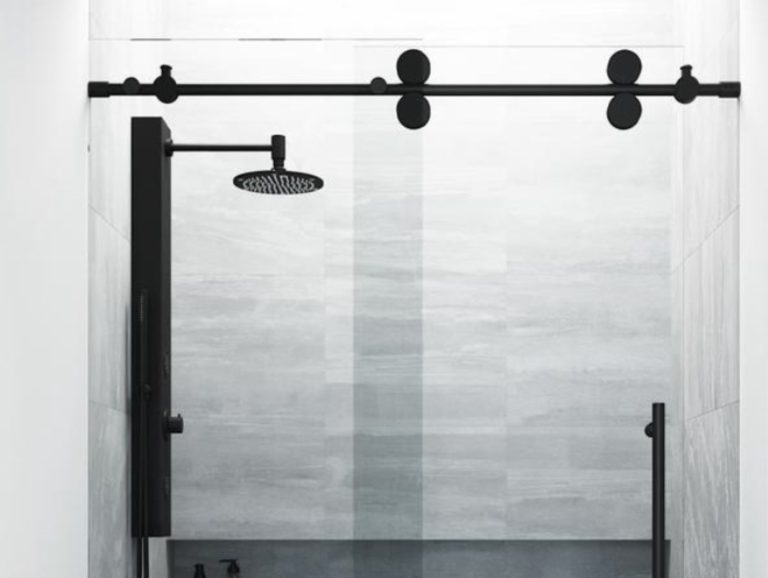
Support bars come in the same finish as the rest of the hardware. In matte black or satin brass, they become a deliberate architectural line. We specify them when the panel size calls for it.
Sealing and Silicone
Fixed panels are sealed where needed at the wall and curb with clear silicone, which keeps water from running behind the glass. Over many years, silicone can discolour or come loose, especially with hard water and harsh cleaners. If you notice gaps or dark lines in the sealant, it can be renewed. Gentle cleaning helps it last.
Frequently Asked Questions
Is channel the same as a frame?
No. A frame surrounds every edge of the glass and carries the load. Channel only holds the fixed edge of a panel, and the glass is still thick tempered glass that stands on its own.
Do clamps leak?
No. Clamped panels are sealed where the glass meets the wall and curb at installation.
Can I switch from channel to clamps on an existing enclosure?
Sometimes, but the glass may need to be re-cut to suit clamps. It is usually simplest when replacing the enclosure.
Which costs more?
The difference is usually small compared with style, size and glass. Our cost guide explains the bigger factors.
Can channel be hidden in the tile?
In some remodels a channel can be recessed so only the glass shows. It needs to be planned before tile. Ask us early.
Do clamps damage the glass?
No. Clamps hold the glass with protective gaskets so metal never touches glass directly.
Want to see both on your opening? Get a free quote with an exact price the same day, often right over the phone. When you are ready, we measure in your home and bring samples. Or call 800-715-0031.
Tempered Safety Glass Explained: Why Every Shower Door Uses It
Is shower door glass safe? How tempered safety glass is made, why it is several times stronger than ordinary glass, how it breaks, and the care that keeps it safe for years.
Shower Door Handle Styles: How to Pick the Right Pull
Compare shower door handle styles: tubular, ladder, mitered, square, traditional and antique. How each feels, which bathrooms they suit, and how to match them to your finish.
Frosted and Privacy Shower Glass: Options, Pros and Cons
Considering frosted shower glass? Compare frosted, light tint and clear glass for privacy, light, cleaning and style, and learn when partial frosting is the best of both.