Tempered Safety Glass Explained: Why Every Shower Door Uses It
By Direct Shower Door · October 2, 2026 · 7 min read
A frameless shower door is a large sheet of glass that you push and pull every day, in a wet room, often with children around. It is natural to wonder how safe that is. The answer is: very, because every shower door we install is made from tempered safety glass. Tempering transforms ordinary glass into something much stronger, and changes how it behaves in the rare event that it does break.
This guide explains what tempered glass is, how it is made, why it is required for shower doors, and the few things worth knowing to keep it in perfect condition.
The short answer
Tempered glass is heated and rapidly cooled, which makes it roughly four times stronger than ordinary glass of the same thickness.
If it breaks, it shatters into small, blunt pieces instead of long sharp shards.
Building codes require safety glazing in shower enclosures. Every panel we install is tempered.
Tempered glass cannot be cut or drilled after tempering, so every hole and edge is made first, and measuring precisely matters.
How Tempered Glass Is Made
The glass is first cut to its final size and shape. Hinge notches, handle holes and clamp cut-outs are made, and the edges are finished. Then the panel goes into a tempering furnace, where it is heated to around 600 degrees Celsius, close to its softening point. Jets of air then cool the surfaces rapidly.
The outer surfaces cool and harden first, while the centre is still hot. As the centre cools, it pulls on the surfaces, locking them into compression, with the centre in tension. That balance of forces is what makes tempered glass so strong: to break it, you first have to overcome all that built-in compression.
Why It Is So Much Stronger
Tempered glass is typically about four times stronger than ordinary (annealed) glass of the same thickness. That strength is why a frameless enclosure can stand without a frame: 3/8 or 1/2 inch tempered glass carries its own weight, the weight of the hardware, and the force of a door being opened and closed thousands of times. See our thickness guide for how thickness adds to that.
How It Breaks, and Why That Matters
Ordinary glass breaks into long, sharp, dangerous shards. Tempered glass breaks completely and all at once into many small, relatively blunt, cube-like pieces. That is the safety in “safety glass”: in the unlikely event of a break, the pieces are far less likely to cause serious injury.
Breakage is rare. When it does happen, the cause is usually damage to the edge, for example a hard knock from a heavy object, or the glass coming into contact with tile or metal because hardware has loosened.
Why Codes Require It
Building codes treat shower and bathtub enclosures as hazardous locations for glass, because people are wet, barefoot and may slip. Glass in these locations must be safety glazing, such as tempered glass. Tempered panels carry a small permanent mark, usually etched in a corner, identifying them as safety glass. Look for it on your own enclosure.
Why It Cannot Be Cut Afterwards
Because the strength comes from the balance of compression and tension, cutting or drilling a tempered panel releases that balance and shatters it. Every cut, notch and hole has to be made before tempering. That has practical consequences:
Measuring must be precise. A panel that is slightly wrong cannot be trimmed on site; it has to be remade. That is why we measure every opening ourselves. See how to measure a shower opening.
Handle and hinge positions are fixed. Changing to a handle with different mounting holes may not be possible. See our handle styles guide.
Protect the edges. The edges are the most vulnerable part. Avoid knocking the glass with heavy objects, and do not let the door swing hard into a wall or fixture.
Watch for a dropped door. If a door sags or starts touching the curb or wall, call us. Glass touching tile or metal is a risk, and hinges can be adjusted.
Check for chips. A chip on an edge is a weak point. If you see one, have it looked at.
Do not use the door as a towel rail or grab bar unless a bar has been designed and installed for that purpose.
Clean gently. Avoid scrapers and abrasive pads. See our care guide.
Tempered Glass Options
All our glass options are tempered: clear, low-iron, frosted and light tint, in 3/8 or 1/2 inch. Compare them below.
◆ Glass Comparison
Compare the glass options side by side
3/8" Clear
The standard for frameless. Light, strong, and shows off your tile.
Solid feel
Clarity
Privacy
1/2" Clear
Heavier and more solid to the hand. The premium feel, especially on big doors.
Solid feel
Clarity
Privacy
Low-Iron
Ultra-clear, without the faint green edge of standard glass. Best against white tile and marble.
Solid feel
Clarity
Privacy
Frosted
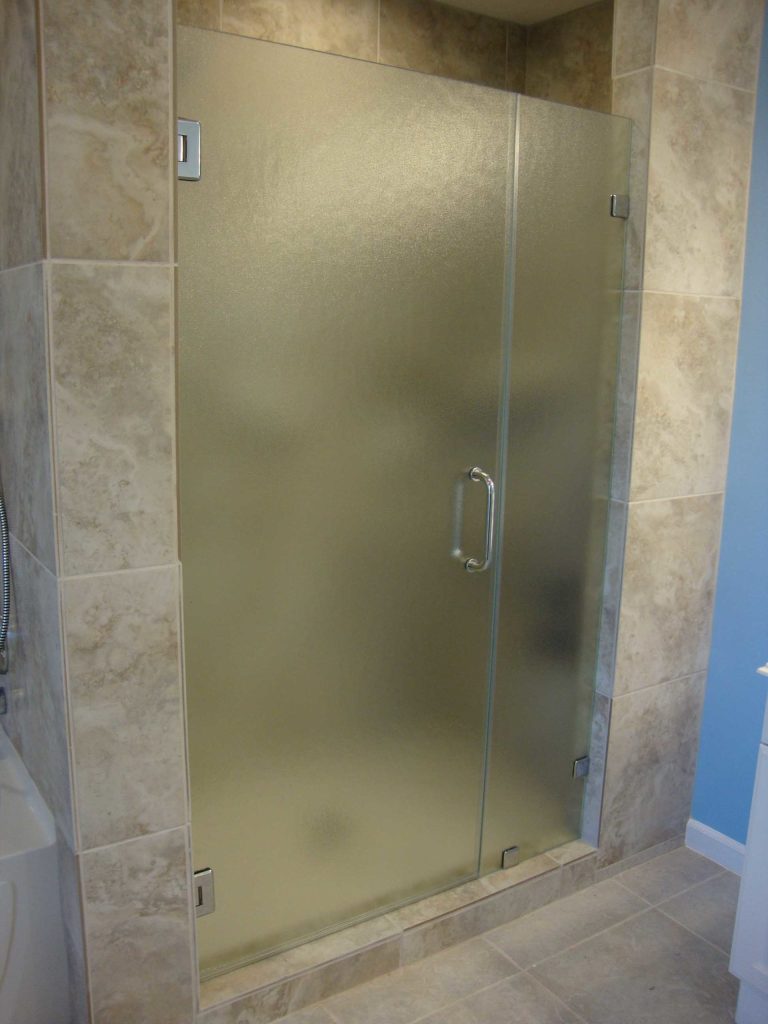
Sandblasted for privacy while still letting light through. Good for shared bathrooms.
Solid feel
Clarity
Privacy
Light Tint
A soft smoke tone that warms a bright bathroom and softens water spots.
Solid feel
Clarity
Privacy
Relative comparisons, not lab figures. See all options on Hardware & Glass.
The door has dropped and the bottom edge touches the curb or sweep tightly.
The door no longer closes evenly or swings on its own.
A hinge or clamp feels loose, or you can see movement when the door closes.
There is a visible chip on an edge or corner.
Glass is touching tile or metal anywhere.
Any of these is worth a call to 800-715-0031. Most are quick adjustments, and catching them early protects the glass.
Common Myths
“Frameless glass is fragile.” Tempered glass is far stronger than ordinary glass, and frameless panels are thicker than framed ones.
“Tempered glass explodes for no reason.” Spontaneous breakage is rare. Most breakage has a cause, usually edge damage.
“Thicker glass is always safer.” Both 3/8 and 1/2 inch tempered glass are safety glass. Thickness affects rigidity and feel.
“Glass can be trimmed on site if it does not fit.” Not tempered glass. That is why the measurement has to be right first time.
Safety in Family Bathrooms
For bathrooms used by children or older family members, a few choices add peace of mind: a door that swings outward (never inward, where someone who falls could block it), a handle at a comfortable height, a slip-resistant floor outside the shower, and grab bars installed into solid backing rather than fixed to the glass. A walk-in with a splash panel removes the door altogether.
Tempered Glass Elsewhere in Your Home
You already rely on tempered glass every day. It is used where glass might be bumped or where breakage would be dangerous, including:
Car side and rear windows.
Oven doors and many glass cooktop components.
Patio and sliding glass doors.
Glass table tops and some shelving.
Glass near floors and doors in buildings, where codes require safety glazing.
Shower enclosures are in the same category for the same reason: people are close to the glass, often wet and barefoot.
Frequently Asked Questions
Can a tempered shower door break on its own?
It is very rare. Most breakage traces back to edge damage or hardware that has loosened and let the glass touch something hard.
How do I know my shower door is tempered?
Look for a small permanent mark etched in a corner of each panel.
Is thicker glass safer?
Both 3/8 and 1/2 inch tempered glass are safety glass. Thicker glass is more rigid and heavier.
Is the glass American made?
Yes. We use American-made glass and hardware.
What should I do if my shower glass breaks?
Keep everyone out of the bathroom, wear shoes, and carefully collect the pieces. Then call us to measure for a replacement panel.
Is tempered glass required by law?
Building codes require safety glazing in shower and tub enclosures. Tempered glass meets that requirement.
Questions about your glass? Get a free quote or call 800-715-0031. We have been installing tempered glass enclosures across Southern California for more than 35 years.
Shower Door Handle Styles: How to Pick the Right Pull
Compare shower door handle styles: tubular, ladder, mitered, square, traditional and antique. How each feels, which bathrooms they suit, and how to match them to your finish.
Channel vs. Clamps: How Your Shower Glass Is Held in Place
U-channel or clamps for frameless shower glass? Compare the look, cleaning, water tightness and how each handles uneven walls, so you can choose the right fixing for your panels.
Frosted and Privacy Shower Glass: Options, Pros and Cons
Considering frosted shower glass? Compare frosted, light tint and clear glass for privacy, light, cleaning and style, and learn when partial frosting is the best of both.